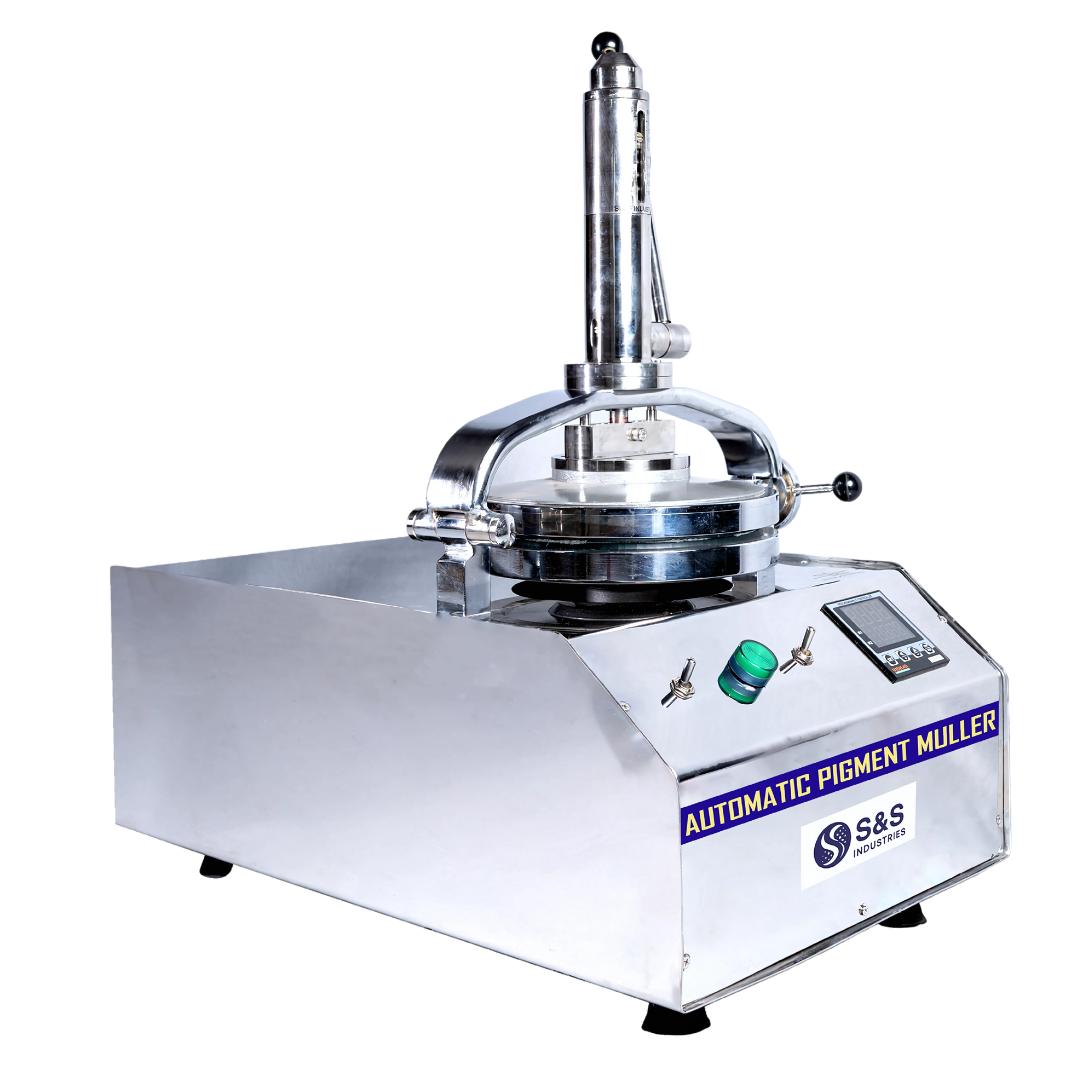
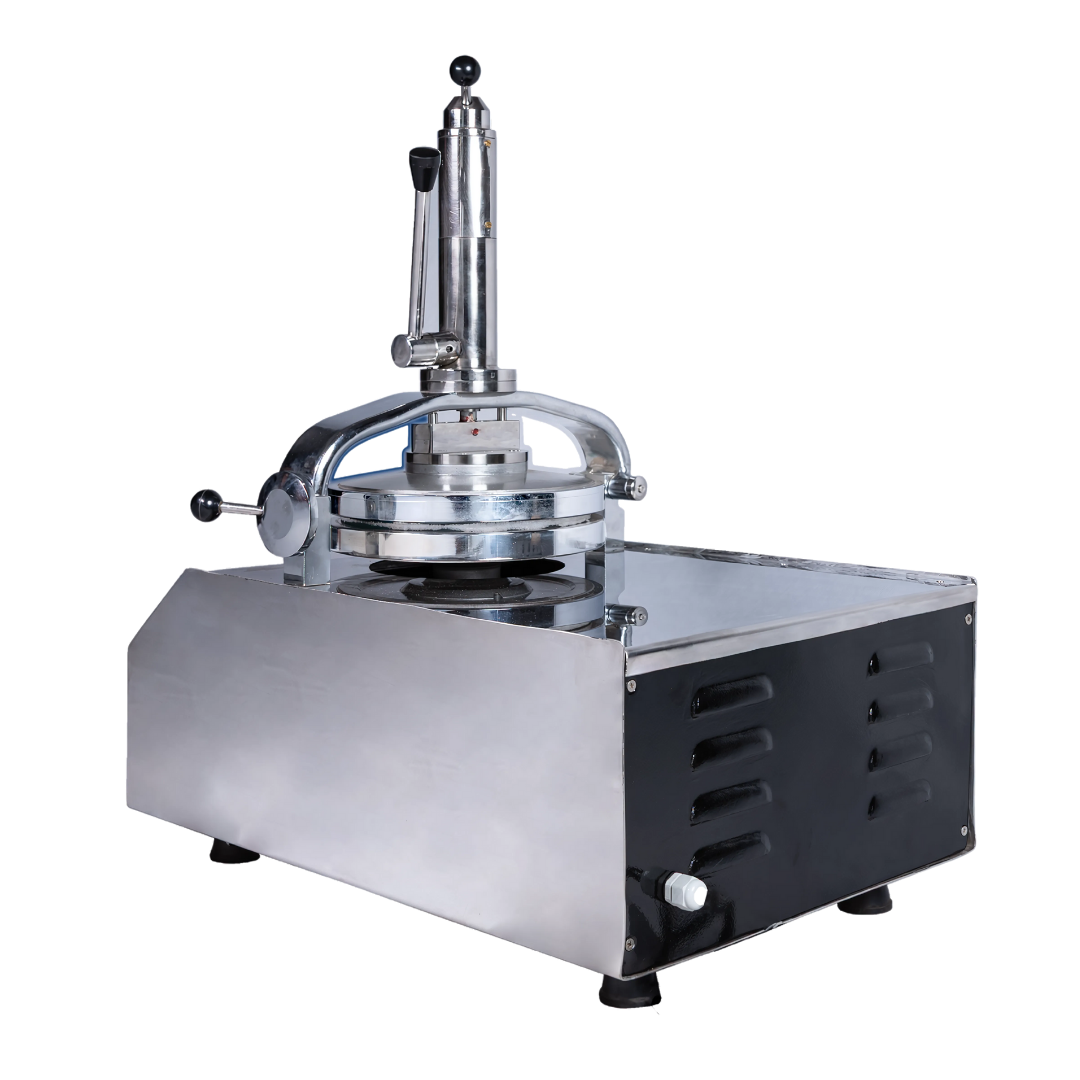
The Hoover Automatic Muller uniformly mixes pigments, vehicles, and other materials under consistent conditions, ensuring precise preparation of paints and test pigments.
The S AND S Industries Automatic Muller is a precision laboratory device designed for efficient pigment dispersion. It offers a quick and reliable method for preparing small pigment-resin samples, ensuring consistent and repeatable results. With a constant rotational speed, uniform pressure, and precise control over the number of rotations, the Muller allows for accurate duplication of dispersion tests using any given pigment or pigment paste.
The dispersing mechanism consists of two glass plates—one stationary and one rotating. These plates, initially 0.375 inches (0.95 cm) thick, should be replaced when their thickness is reduced to 0.365 inches (0.93 cm). Each plate has a diameter of 7.75 inches (19.7 cm) and is manufactured with a surface quality grade of 3. To ensure secure placement, aluminum locking rings hold the plates in position.
The operation of this system is comparable to a waffle iron, where the top plate is lowered onto the bottom plate and locked in place. The top plate is attached to a compression bracket, which is secured to a weight lever. This lever is connected to a stationary weight shaft that supports the grinding weights. Each weight applies 22.7 kg of vertical force onto the top plate, with up to three weights available for use depending on the desired dispersion level.
The rotating plate operates at 100 RPM, driven by a sprocket chain. When the plates are closed and the machine is activated, the pigment and resin are dispersed together. The rotating plate shears the pigment into the resin, producing paint, ink, or other vehicle dispersions.
Factors Affecting Dispersion Rate
The dispersion rate can be adjusted based on the following six factors:
Type of glass plate used – Ground (frosted) glass plates provide high-shear dispersion, while smooth (clear) plates produce lower shear.
Number of weights used – Increased weights result in greater pressure and enhanced dispersion.
Number of revolutions – More revolutions increase dispersion intensity.
Viscosity of the vehicle – Higher viscosity affects shear force and pigment distribution.
Solids content of the vehicle – Impacts the overall dispersion quality.
Pigment-to-vehicle ratio – Affects the consistency and effectiveness of the dispersion.
High-Shear Dispersion: To simulate ball mill production, use frosted glass plates, three weights, and a higher number of revolutions. Lower-Shear Dispersion: To simulate a high-speed disperser, use smooth glass plates, fewer weights, and lower revolutions.
Operational Guidelines
For standard applications, operate under 46 Kg of pressure (two weights) and limit runs to 25 cycles at a time.
Never operate with dry plates—it is essential to keep the plates wet, especially at the center, to ensure maximum dispersion.
Maintain a minimum plate thickness of 0.365 inches (0.93 cm) for optimal performance.
Small scratches on the plate surface can be removed using a water-based grinding paste.
The built-in digital counter can be manually set between 1 and 999 revolutions using push buttons on the control panel. The counter starts via a start switch and stops automatically once the preset number is reached. The machine can also be manually stopped using the stop switch.
S AND S Industries is committed to providing high-quality pigment dispersion solutions for laboratories and industrial applications.
Glass
Cooled type glass plates
S S Body
Spring type leverage
Tailor-Made Solutions
With our expertise, we cater to diverse and specialized project requirements by delivering tailored solutions—such as the AUTOMATIC PIGMENT MULLER—to meet your specific process needs.
With our local branches and on-site technical experts, we are proud to serve you as a trusted engineering company and experienced process specialist “*” indicates required fields